
Bybit Review: A Platform Built Around Traders, Not Just Trading
Bybit rarely tries to compete with exchanges like Binance on “everything at once.”
Instead, it follows a very deliberate strategy: own the derivatives-first trading experience and build everything else around that core.
This review explores Bybit not as a generic crypto exchange, but as a platform designed with a specific user mindset in mind — traders who care about execution, risk control, and interface precision more than sheer ecosystem size.
The analysis below is based on extended platform usage, feature testing, and comparison with other major derivatives-focused exchanges.

The Philosophy Behind Bybit’s Product Design
Understanding Bybit starts with understanding what it doesn’t try to be.
Bybit does not overload users with dozens of loosely connected products. Instead, it builds vertically — refining fewer tools to a very high standard.
This approach shows up everywhere:
- Cleaner interface hierarchy
- Strong emphasis on execution clarity
- Risk metrics placed front and center
- Less noise, fewer distractions
The result is a platform that feels intentional rather than crowded.
Market Focus: Why Bybit Attracts Active Traders
Asset Selection With Purpose
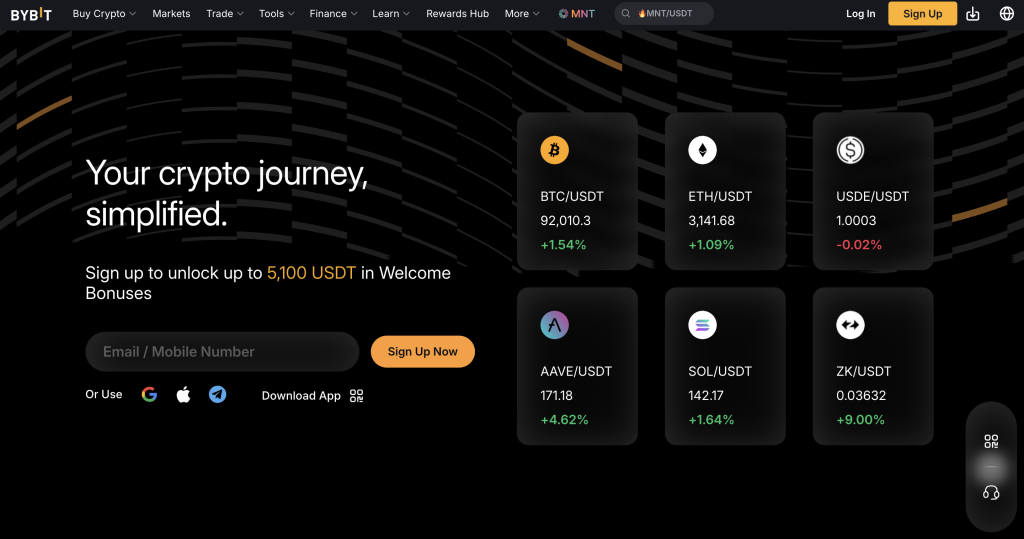
Bybit supports fewer cryptocurrencies than Binance — and that is not an accident.
Most listed assets fall into three categories:
- High-liquidity majors (BTC, ETH, SOL, etc.)
- Actively traded mid-cap altcoins
- Volatility-friendly derivatives instruments
This curation improves liquidity concentration and reduces the “dead market” problem where assets exist but cannot realistically be traded.
Liquidity Where It Matters
On popular perpetual contracts, Bybit’s order books are deep, responsive, and stable even during sharp market movements. Slippage is generally predictable, which is critical for leveraged strategies.
Futures and Perpetual Contracts: The Core of Bybit
If Binance is an all-in-one ecosystem, Bybit is a derivatives specialist.
Futures Trading Environment
Bybit offers:
- USDT-settled perpetuals
- Inverse contracts
- Adjustable leverage per position
- Isolated and cross margin modes
What truly stands out is how clearly risk is communicated:
- Liquidation price updates in real time
- Margin ratio displayed visually
- Funding rates explained without ambiguity
For experienced traders, this transparency reduces emotional trading and improves decision-making under pressure.
Risk Management Tools: Where Bybit Really Differentiates
Many exchanges offer risk tools. Bybit actually integrates them into the trading flow.
Key Risk Features
- Position-based stop-loss & take-profit
- Partial position closing
- Insurance fund transparency
- Auto-deleveraging indicators
Instead of hiding complexity, Bybit surfaces it in a way that feels manageable rather than intimidating.
This is especially valuable in volatile markets, where poor UI can be as dangerous as bad strategy.
Trading Interface: Precision Over Decoration
Bybit’s interface feels engineered, not styled.
Every element serves a purpose:
- Charts load fast and stay responsive
- Order panels are logically grouped
- Market depth is readable at a glance
- Position data never feels buried
For traders who spend hours on charts, this reduces fatigue and cognitive load — an underrated advantage.
Fees: Competitive, But Strategically Structured
Bybit’s fee model is designed to reward active participation.
Futures Fees Overview
- Maker fees are extremely competitive
- Taker fees remain reasonable for market execution
- VIP tiers scale logically with volume
Unlike platforms that quietly adjust spreads, Bybit keeps costs explicit. Traders know exactly what they are paying and why.
Spot Trading: Secondary, But Solid
Spot trading on Bybit exists primarily to support derivatives workflows:
- Asset acquisition
- Position hedging
- Capital rotation
While not as feature-rich as dedicated spot exchanges, execution quality remains reliable, and the interface stays consistent with the rest of the platform.
Bybit Earn and Passive Products: Conservative by Design
Bybit’s yield products are noticeably more restrained than some competitors — and that restraint feels intentional.
Earn Products Include
- Fixed-term savings
- Dual asset products
- Structured yield offerings
Returns are competitive but not marketed aggressively. Risk disclosures are clear, and mechanics are explained in plain language.
This conservative framing aligns well with traders who already manage significant exposure elsewhere.
Security Practices and Platform Stability
Bybit emphasizes operational stability as much as technical security.
Security Highlights
- Cold wallet custody
- Mandatory two-factor authentication
- Withdrawal verification layers
- Regular system audits
More importantly, Bybit has historically handled periods of extreme volatility without prolonged outages — a key trust factor for active traders.
Regulatory Positioning and Platform Access
Bybit operates globally with region-specific compliance adaptations. Certain features may be limited depending on jurisdiction, but enforcement is generally consistent and transparent.
Account-level controls, KYC tiers, and withdrawal limits are clearly defined, reducing uncertainty for users.
Strengths and Limitations in Real Use
What Bybit Does Exceptionally Well
- Derivatives trading experience
- Risk visualization and control
- Clean, trader-focused interface
- Reliable execution during volatility
- Logical fee incentives
Where Bybit Falls Short
- Smaller ecosystem compared to all-in-one exchanges
- Fewer passive income options
- Less beginner-friendly onboarding
Who Bybit Is Actually Built For
Bybit excels when used by:
- Active futures traders
- Scalpers and swing traders
- Users who prioritize execution quality
- Traders who want fewer distractions
It is not designed to be a crypto “super-app” — and that clarity is part of its strength.
“Bybit doesn’t try to simplify trading. It tries to make complex trading more controlled.”
Final Evaluation
Bybit has carved out a clear identity in a crowded market.
Rather than chasing every trend, it focuses on delivering a high-performance trading environment where execution, risk management, and interface design work together seamlessly.
For traders who live in derivatives markets, Bybit is not just competitive — it is often preferable.